
How Underfloor Heating Works: The Complete Beginner’s Guide
Underfloor heating (UFH) is no longer just a luxury — it’s becoming a popular, energy-efficient alternative to traditional radiators in UK homes. But how exactly does it work?
Whether you’re building a new home, upgrading a renovation, or just curious, this guide breaks down the basics of underfloor heating in a way that’s simple, practical, and jargon-free.

What Is Underfloor Heating?
Underfloor heating is a system that distributes warmth across the floor surface, gently heating a room from the ground up. This creates even, radiant heat, unlike radiators which rely on convection (heating the air near them first).
There are two main types of systems:
- Electric underfloor heating (dry systems)
- Water underfloor heating (wet systems)
Electric Underfloor Heating (Dry Systems)
Electric UFH uses a network of heating cables or mats laid directly under your floor finish. Once switched on, the cables heat up and warm the floor above.
How it works:
- Cables or mesh mats are installed on top of insulation and a subfloor.
- The system is wired into your mains electricity supply.
- A thermostat controls temperature and timing.
Best for:
- Bathrooms, kitchens, and small renovations
- Properties where space is limited or retrofitting is required
Let’s explore how each one works.
Water Underfloor Heating (Wet Systems)
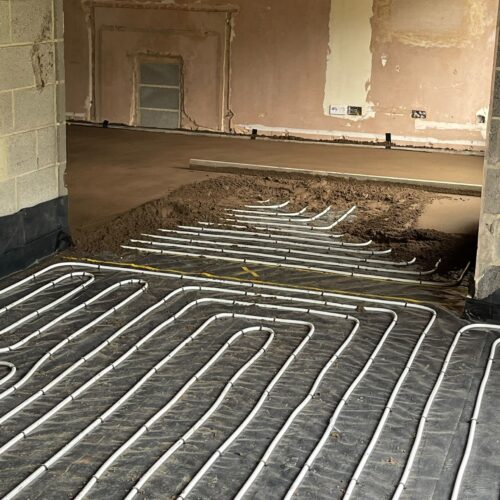
This system uses warm water circulated through a series of flexible plastic pipes embedded in the floor structure (usually in a screed layer or between floorboards).
How it works:
- A heat source (like a boiler or heat pump) warms the water.
- A manifold controls the water flow to each zone.
- The pipes evenly distribute warmth across the floor.
- The floor surface gently radiates heat upward.
Best for:
- New builds and whole-house installations
- Homes using renewable energy like air source heat pumps
Key Components of an Underfloor Heating System
- Heating source (boiler or electrical supply)
- Pipes or cables
- Insulation boards (to prevent downward heat loss)
- Screed (to embed the system, for water UFH)
- Thermostats and zone controls
Manifold (for water systems only)
Why Underfloor Heating Is More Efficient Than Radiators
- Lower operating temperatures: UFH heats large areas at 30–50°C vs radiators at 70–80°C.
- Even heat distribution: No cold spots or hot corners.
- Invisible and space-saving: No wall clutter or bulky radiators.
Ideal for renewable systems: Works brilliantly with heat pumps and solar panels.
Which Flooring Works Best with Underfloor Heating?
Good floor coverings conduct heat efficiently — that means materials like:
- Ceramic or stone tiles
- Engineered wood
- Vinyl flooring
- Low-pile carpet (with correct underlay)
Poor conductors like thick carpet or uninsulated timber can reduce performance.
FAQs
Q: Does underfloor heating take longer to heat a room?
A: Yes, but it retains heat longer and provides a more consistent temperature.
Q: Is underfloor heating safe?
A: 100% — modern systems are low-voltage (electric) or low-temperature (water) and designed to be safe and regulated.
Q: Can I use underfloor heating with any boiler?
A: Most modern boilers are compatible, but a heat pump may be even more efficient.
Still not sure which underfloor heating system is right for your home?
Let Interior Screed Ltd help. Our experienced team can walk you through the options, assess your property, and provide a bespoke solution that fits your space, budget, and energy goals.
Contact us today for expert advice and a no-obligation quote.